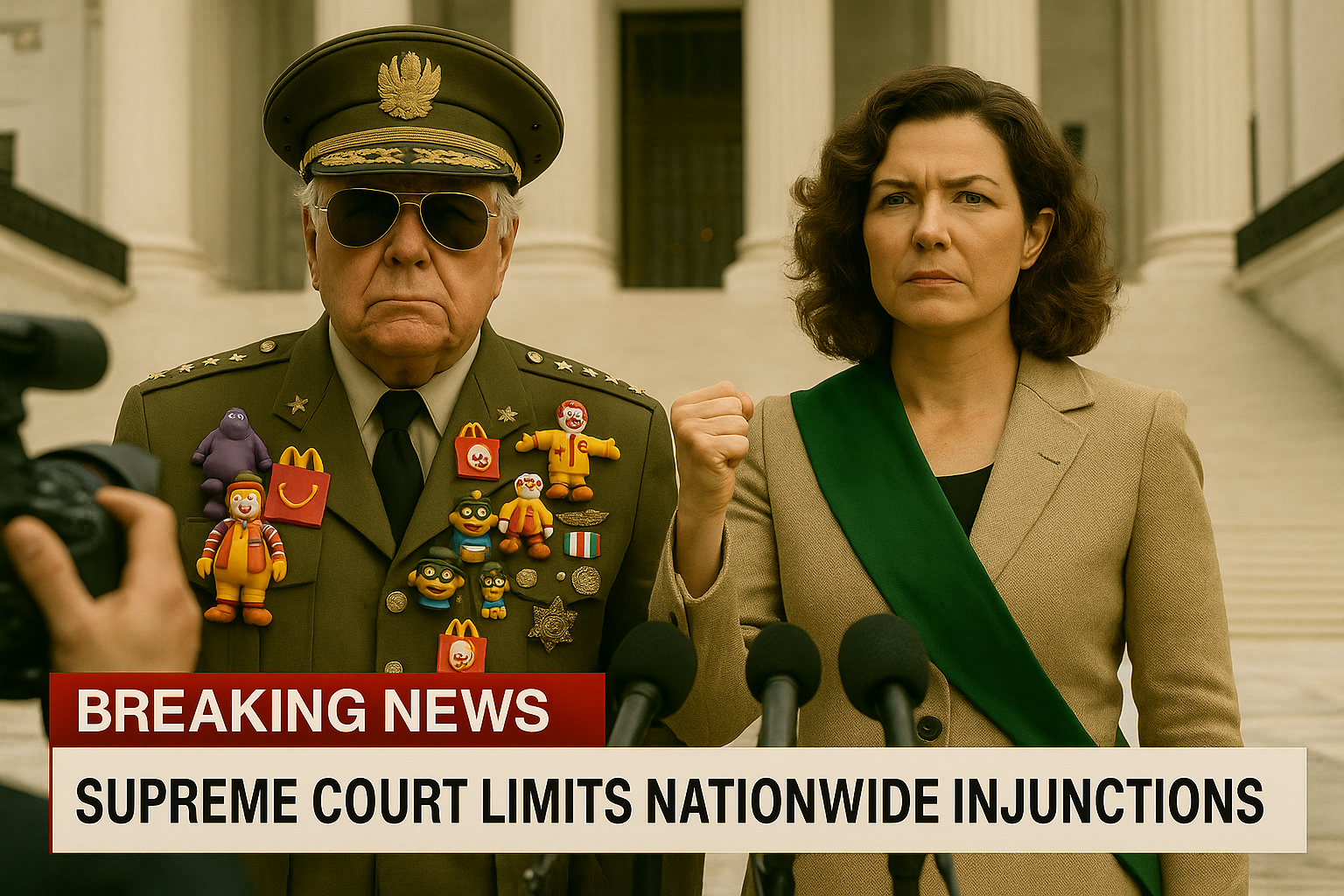
Crump and Congress woman argue about the injunction
Supreme Court Limits Nationwide Injunctions in 6–3 Ruling
Published: June 28, 2025
By Sockman & Fish
On June 27, 2025, the U.S. Supreme Court issued a landmark decision drastically narrowing federal district judges’ ability to issue nationwide injunctions—a tool that, until now, could freeze policies for every American while a case wound its way through court.
Justice Barrett:
“The power to grant nationwide relief lies not with a single judge interpreting statutes beyond their text, but with the people’s elected representatives in Congress.”
(Sockman whispers: “Finally, no more judicial happy hours handing out free samples of injunctions.”)
The Core Holding
In a 6–3 opinion authored by Justice Amy Coney Barrett, the Court held that lower courts may only provide relief to the parties before them. Barrett stressed that neither history nor statute authorizes a judge to halt nationwide policy single‑handedly. Instead, any expansion of this relief must come via Congress—where, presumably, everyone has to queue for a turn.
(Fish surfaces: “So, it’s whack‑a‑mole with lawsuits now. Grab your mallet!”)
Background: The Rise of Nationwide Injunctions
Since the early 2010s, district courts have leveraged nationwide injunctions to pause executive actions—blocking travel bans, freezing healthcare mandates, and halting environmental rollbacks. Advocates called these orders “essential shields”; critics said they turned one judge into a policy czar.
(Sockman: “Essential shields or rogue scepters? Take your pick!”)
High-Profile Cases Impacted
- Travel Bans: Multiple courts put the brakes on entry restrictions.
- Healthcare Regulations: Nationwide freezes on agency rules for insurance coverage.
- Environmental Measures: Blocks on rollbacks of air and water standards.
(Fish: “Guess climate regulations are now on the fast track—at snail’s pace.”)
The Birthright Citizenship Dispute
The decision sprang from President Crump’s executive order ending automatic citizenship for U.S.-born children of undocumented immigrants. Lower courts responded with nationwide injunctions under the 14th Amendment; the Supreme Court’s June ruling didn’t address whether that order is constitutional but stripped courts of their power to apply it broadly—at least until each affected person files suit.
(Sockman: “Birthright on hold—just like my Amazon Prime, but with less drama.”)
Washington’s Reactions
President Crump:
“Today, the Supreme Court reaffirmed our system of checks and balances. This decision empowers the executive to enforce laws fairly, without unilateral court orders halting nationwide policy.”
Rep. Liberty Rainstorm (D–Orion):
“This ruling tears away vital legal protections from marginalized communities. When one voice speaks for all, many will be silenced.”
(Fish: “Cheers to checks and balances—may the judiciary get its own reality show.”)
Attorney General Maria Santos praised the decision for removing “artificial roadblocks” to enforcement. Meanwhile, civil‑rights groups warned it “undercuts judicial oversight” of potentially unconstitutional policies.
(Sockman: “Roadblocks removed—guess we’ll hit those speed bumps next.”)
Dissenting Voices
Justices Sotomayor and Brown Jackson issued pointed dissents, arguing that nationwide injunctions are indispensable for protecting minority rights and ensuring uniform application of constitutional guarantees.
(Fish: “Dissenters: the Senate Minority Report of robes.”)
Looking Ahead
– Class-Action Litigation: Groups plan coordinated suits to approximate nationwide relief via aggregated plaintiffs.
– Legislative Response: Bipartisan bills in the wings to codify when broad injunctions are permissible.
– Next Supreme Term: A direct fight over the 14th Amendment birthright question looms, and the Court’s new injunction rules will shape every emergency filing that follows.
As the Court recesses until October, this recalibration of judicial power will ripple through courts, Congress, and the next administration.
Sockman’s Take
Sockman here—let’s be real: the Court just turned nationwide injunctions into boutique remedies. If you thought Supreme Court drama was a once-a-term affair, buckle up: now every doorstep will host its own mini-courtroom saga. Grab your popcorn and legal pads—this is far from over.
(Sockman & Fish sign off: “See you back here when someone sues over parking tickets nationwide.”)
About the Author